Karl Rosenfield Peony Flower Size and Bloom Form
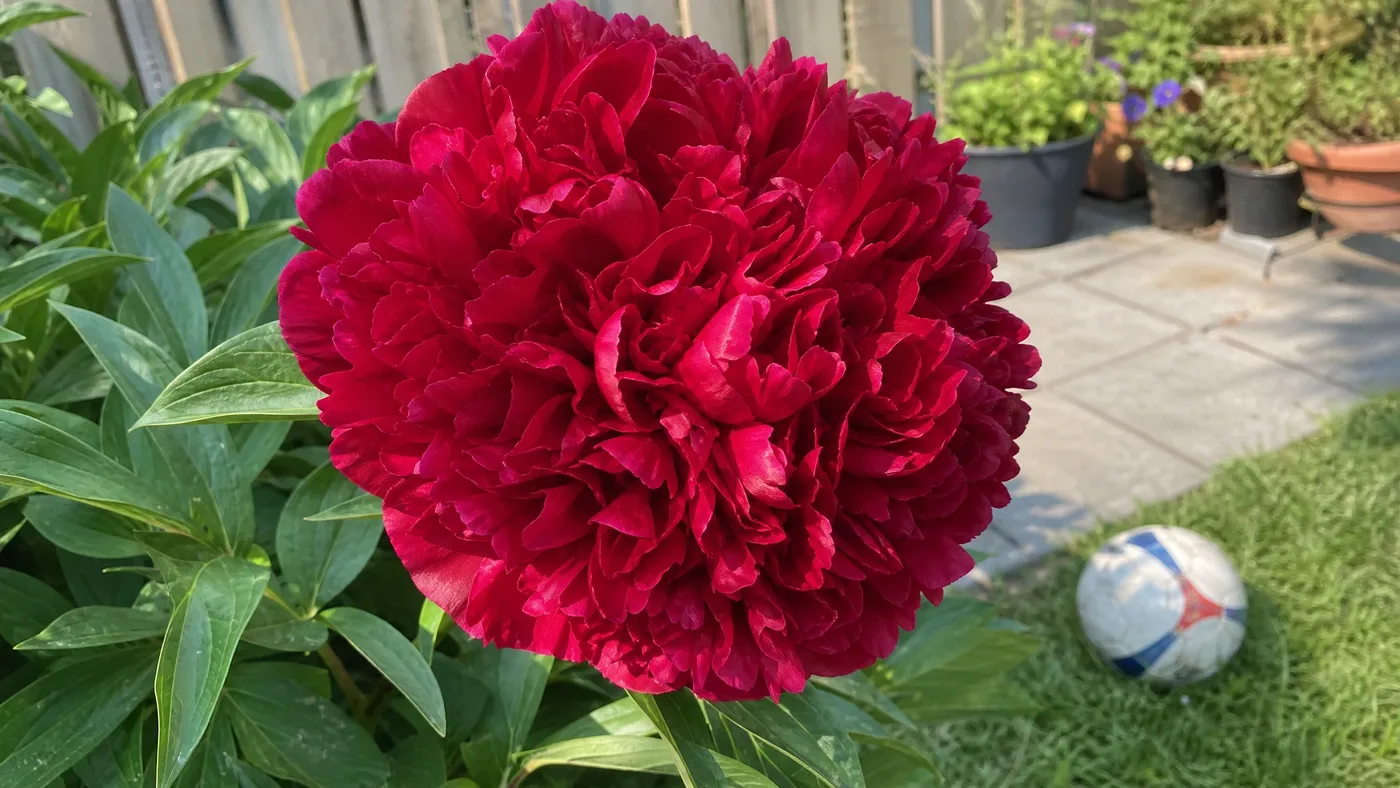
Stand at the far end of the lawn in early summer and a Karl Rosenfield Peony is hardly a flower at all. It is a spot of red, a warm patch against the green that your eye finds before it finds anything else. Walk toward it and the spot turns into a clump, then a single round bloom, then a heap of ruffled petals you could study for an hour.
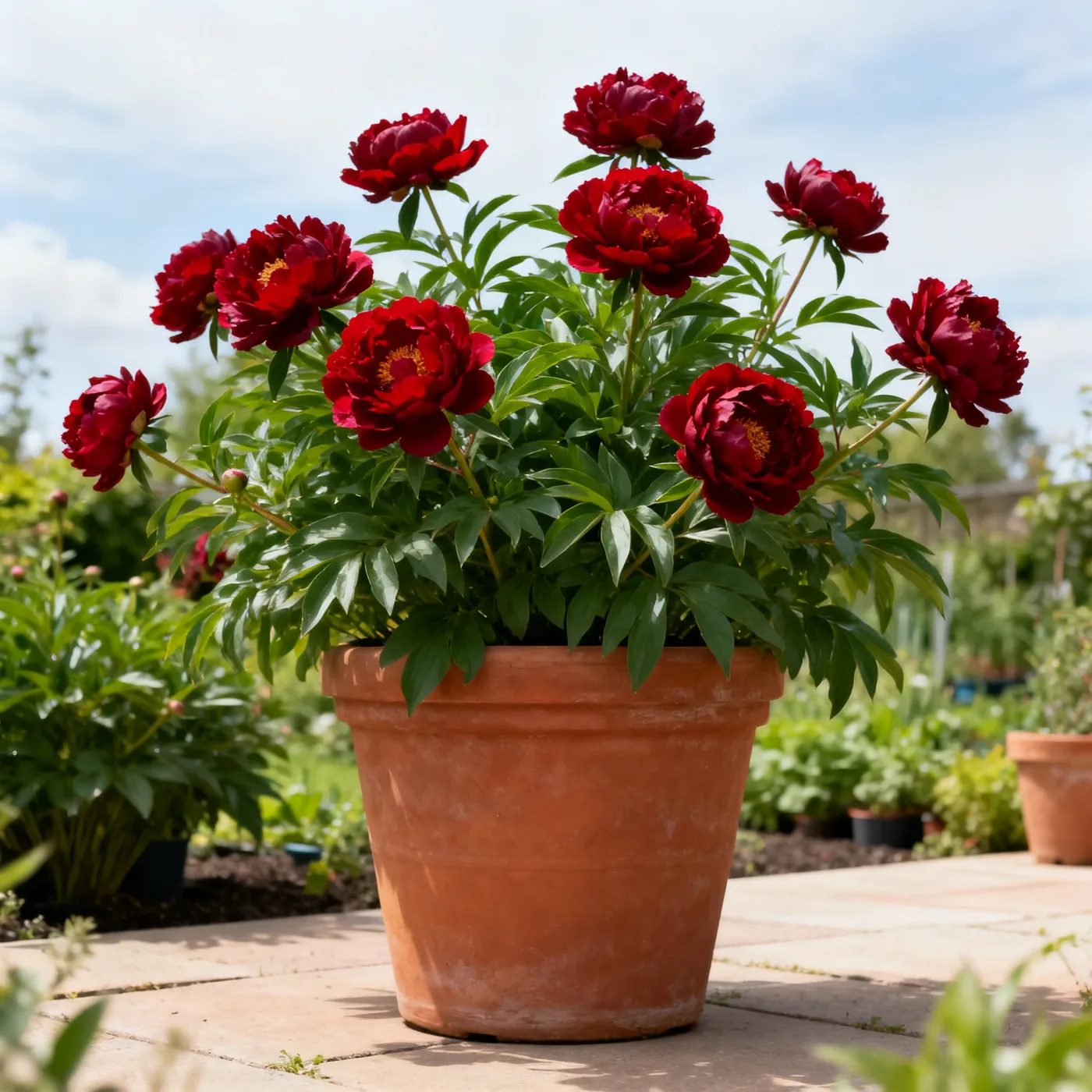
This article talks about Karl Rosenfield flower size and bloom form and answers the questions customers ask us most. Read on to learn how the blooms read from across the garden, how a clump holds them, how wide one flower measures, how to count petals, what "bomb" means and what to look for at the center.
Each step closer teaches you something the one before could not, and the details explain why this old crimson peony still earns its place in a cutting garden.
Seeing Karl Rosenfield Peony From Across the Garden
From thirty paces, you do not see petals. You see color, and the color is a deep crimson red that holds its strength in full sun while paler flowers wash out. The flowers are double, crimson red and fragrant, and from a distance the doubleness matters because a full bloom reads as a solid disc rather than a ring with a hole in it.
Size of the plant sets the scale of that view. Herbaceous peonies run about 1 to 3 feet tall and wide, so a clump sits at knee to waist height and its blooms ride just above the leaves. Our guide on how big Karl Rosenfield gets covers the plant itself, so here we stay with the flowers.
Plant for the Distant View
Give each clump 3 to 4 feet between peonies. At that spacing, neighboring clumps stay separate, and from far off each one shows as its own red mark in the border. Crowd them and the marks merge into one muddy band.
Time the picture too. The bloom period is May to June, and that window is when the far-lawn view works. Put the clump where you will actually be looking from, whether that is a porch, a path or a kitchen window, and read our notes on landscape uses and companions for what to plant beside it.
How One Clump Holds Its Flowers
Step up to a mature clump in bloom and look at how the flowers sit. Each stem ends in a large main bud, and the open blooms nod and lean in every direction rather than facing one way. A single clump becomes a loose bouquet that arranges itself.
Stems and Weight
A double bloom is heavy, and it gets heavier when wet. This peony may need support, and that matches what customers tell us after their first big June rain. One of the most common questions we get is why a stem that stood up fine in the morning is lying on the grass by evening.
Our advice is to set a ring or grid over the clump in early spring, while the shoots are short, and let the foliage grow up through it. Adding a stake after the buds swell damages stems and never looks right.
Why Cutters Love the Habit
Cut flowers are also a suggested use. Because the blooms are held well above the leaves, you can reach a stem and cut it long. Take a few from each clump and leave the rest, so the border still shows its red from across the lawn. Keep cut stems away from pets, since peony is toxic to dogs, cats and horses.
Karl Rosenfield Peony Flower Diameter, Measured Honestly
Seed catalogs and plant tags like round numbers, so before you trust any figure, put a ruler to a flower. K-State lists this cultivar's flowers as up to about 6 inches wide. Notice the words "up to." That is a ceiling for a well-grown plant on a good day, not an average for every bloom.
You may see larger numbers quoted elsewhere. We treat that figure as the reference and let your own ruler settle the question for your own plants.
How to Measure One Bloom
Follow these steps so your numbers can be compared from year to year.
- Wait until the flower is fully open and the outer petals have relaxed. A cupped, half-open bloom reads small.
- Measure in the cool of the morning, before heat opens the petals past their natural shape.
- Lay the ruler across the widest point of the bloom, from the tip of one outer petal to the tip of the opposite one. Do not press or flatten the petals.
- Turn the ruler a quarter turn and measure again, then average the two readings.
- Write down the date and the plant's age, and repeat on two or three blooms.
Why Young Plants Measure Smaller
Age changes the answer. Peonies of this species take 2 to 5 years to reach maturity, and the blooms usually grow in size and number as the clump settles in. A first-year flower measuring well under 6 inches is normal. If yours is not flowering at all yet, see why a peony may not bloom.
Counting Petals Layer by Layer
Pick a fully open bloom and look straight down into it. You will see rings, and every ring is made of petals that get smaller as you move inward. That is what the term "double" means: more petals than the single ring of five to ten that a wild peony carries, packed in layers.
These flowers are double, but we know of no trusted petal count. Be wary of any site that gives you a single exact number. Counts change from bloom to bloom and with the age of the plant, so build your own range by counting several flowers.
A Method That Works
Counting a whole bloom by eye gives you a different answer every time, so count in layers instead.
- Start with the outer ring, the broad petals that cradle the flower. Count them first, because they are the easiest to see and the easiest to compare between plants.
- Move to the middle ring, where petals are shorter and begin to ruffle. Use a pencil tip to hold your place as you count around.
- Treat the inner crowd as one mass. Its petals are too small and too tight to count without taking the flower apart, and you do not need that number.
Record outer petals for each bloom. That one figure is quick to get and is the measure we ask you to use in the exercise at the end of this guide.
What "Bomb" Means in a Karl Rosenfield Peony Bloom
Peony growers sort double flowers by shape, and "bomb" is one of those shapes. Picture a pom-pom: a flat ring of broad outer petals with a rounded, tightly packed ball of smaller petals rising from the center. That dome is the bomb. It is the form you see when a double peony looks like a scoop of ruffled crimson sitting in a collar.
How Bomb Differs From Other Forms
The easiest way to understand the bomb is to compare it with its neighbors.
A single peony has one ring of petals and a bright cluster of stamens in the open middle. A semi-double has several rows of petals and keeps its stamens showing. A bomb double has so many center petals that the middle becomes a ball rather than a bowl, and the stamens are mostly hidden. Other double forms spread their petals in flatter, more even layers, closer to a rose.
This shape affects how you grow it. A dome of petals holds more water and weighs more than a flat flower, which loops back to the support we described earlier. If you want to compare Karl Rosenfield with another red double, our page on Karl Rosenfield versus Felix Crousse sets them side by side.
Inside the Center of a Karl Rosenfield Peony Flower
Now lean in close, as close as your nose. This is where the bomb shape either shows or hides, and where a good bloom proves itself. The center petals are the smallest in the flower, crowded, folded and ruffled, and they often look a shade deeper than the outer ring because they overlap so densely.
What to Look For
Start with the dome. A healthy bloom has a full, rounded center with no obvious gap. Next, look for stamens. In a tight bomb they are usually buried, and you may see only a few yellow tips near the base or none at all. If you find a bright, open ring of stamens, you are looking at a looser, more open bloom, which can happen on young plants or in hot spells.
Finally, breathe in. The flowers are fragrant, and the scent is strongest when the center is fully open. Wet weather can leave the dense middle damp and slow to open, so after a storm tip the stem gently to shed water rather than leaving it to sit.
We grow and sell Karl Rosenfield Peony, and a mature plant from us will give you this same dense center to examine for yourself.
Big Garden Color Built From Fine Detail
Step back to the lawn and the whole picture comes together. The red patch you saw at the start is thousands of small ruffled petals, grouped into layers, domed into a ball, carried on stems that need a little help to stay upright. Size and form are the same story told at three distances.
Here is how the scales line up.
| Scale | What you see | What to check |
|---|---|---|
| Across the garden | A spot of crimson red in May to June | Spacing of 3 to 4 feet so clumps stay separate |
| One clump | Heavy blooms nodding on stems | Support set in early spring |
| One flower | A double bloom up to about 6 inches wide | Widest tip-to-tip measurement |
| The center | A dome of ruffled petals, stamens mostly hidden | Outer petal count and a full, rounded middle |
For the timing and color side of the story, our guide to bloom time, color and how long it lasts picks up where this one stops.
Karl Rosenfield Peony, From the Lawn to the Center
A Karl Rosenfield bloom is a red mass at a distance, a nodding bouquet on the clump, a double flower up to about 6 inches across and a bomb of ruffled petals at the heart. Measure it, count it by layers and you will know your plant far better than a tag can tell you.
Try one last exercise this season. Pick a fully open bloom, measure it across the widest point and count its outer petals, then compare your numbers with the figures in this guide. Do it again next year and watch the clump grow into its flowers.
Karl Rosenfield Peony
Nursery-grown Karl Rosenfield Peony in sizes from 2 Gallon, shipped to your door.
From $62.95
Shop Now →Karl Rosenfield spends its seasons on our farms in full sun, planted in deep, humus-rich soil, and that is where the big crimson doubles you just measured get their start. Everything we offer comes from stock we raise ourselves, as a small grower-run outfit that puts top-quality plants first. See which ones are ready in the shop today and pick the clump whose blooms you want to measure next June.