Is Karl Rosenfield Peony a Tree, Itoh, or Herbaceous Peony?
The part of Karl Rosenfield that matters most is the part you never see: a crown of red eyes sitting just under the soil. Each eye is a bud holding next year's stem, and that one fact is what separates this peony from a tree peony and from an Itoh hybrid.

Plenty of people reach this plant by searching whether it is a tree peony or an Itoh, and the answer changes what you do in November. Mistake it for a woody shrub and you may wait all winter for stems that were never going to stay. Treat it as what it is and it gives you dark red double blooms for decades.
We'll walk you through how a herbaceous peony builds its year, then how tree and Itoh peonies differ, then what Karl Rosenfield does in each season and what you should do about it.
How a Herbaceous Peony Builds Its Year
Karl Rosenfield is a Paeonia lactiflora, the species many people call the Chinese peony, and it is herbaceous. That word describes how the plant is built, not how it looks. Everything above ground is temporary, and everything that matters sits at or below the soil line.
Roots and Eyes
A mature plant carries thick, fleshy storage roots that hold the energy for a full set of stems each spring. At the top of those roots is the crown, and on the crown sit the eyes: small red or pink buds shaped like pointed knobs. Every stem you will see next year is already waiting as an eye by the end of this year's season.
That is why we tell customers to treat the crown as the plant's whole future. Damage the eyes and you lose stems. Bury them too deep and the plant puts up healthy leaves but few or no flowers, which is the most common way a good peony ends up disappointing its owner.
The Annual Cycle
In spring the eyes break open and red shoots rise, then leaf out into a mound roughly 1 to 3 feet tall and wide. Flowers follow in late spring or early summer. After bloom the leaves keep working, sending energy down to the roots through summer and early fall.
Frost ends the season above ground. Stems and leaves collapse, and the plant goes dormant with its eyes tucked just under the soil. Iowa State Extension says it plainly: herbaceous peonies typically die back to the ground every winter.
Why the Cycle Rewards Patience
Because the plant rebuilds its stems from stored energy every year, it does not behave like a shrub that adds wood and size each season. The crown thickens slowly, adds eyes, and sends up more stems as it matures. That is why an established clump looks so much fuller than the single-stem plant you set in the ground.
It also means the plant does not mind being left alone. A peony that is not dug up, divided or buried tends to keep going for decades, which is the whole appeal of planting one for the long haul.
Why Do Tree Peonies Keep Their Wood?
Tree peonies, Paeonia suffruticosa, run on the opposite plan. In the home landscape they are woody shrubs, not trees, and they produce woody stems that survive above the ground over the winter. The name misleads people, because a tree peony stays shrub-sized in a home garden.
Because those stems live on, the flower buds sit on old wood instead of at the soil line. In winter you see a bare framework of branches, and you leave it alone apart from removing anything dead. Cutting it to the ground the way you would a Karl Rosenfield would remove the very wood that carries the buds.
Tree peonies also keep an earlier schedule, since they typically bloom before the common herbaceous peony. That makes them a lovely way to open the peony season, but it is a different plant with different pruning rules. Advice written for one will quietly hurt the other.
A simple test works at any time of year. If the plant has bark-covered stems standing in January, it is a tree peony. If the bed is bare soil with perhaps a few pink or red knobs at the surface, you are looking at an herbaceous plant, and that is exactly what Karl Rosenfield looks like.
Where Itoh Hybrids Fit Between the Two
Itoh peonies, also called intersectional hybrids, are crosses between tree and herbaceous peonies, named after Japanese hybridizer Toichi Itoh. Karl Rosenfield is not one of them. It is a straight Paeonia lactiflora cultivar with no tree peony parent, and it belongs among the herbaceous cultivars.
The confusion is understandable, because Itoh peonies often die back to the ground each winter like herbaceous peonies. In January the two beds look the same: bare soil. The difference shows up in timing, since Itoh peonies start blooming as the common herbaceous peonies start to fade.
This table puts the three types side by side.
| Type | Winter habit | Parentage | Bloom order |
|---|---|---|---|
| Karl Rosenfield (herbaceous) | Dies to the ground | Paeonia lactiflora | May to June |
| Tree peony | Woody stems stay standing | Paeonia suffruticosa | Before herbaceous peonies |
| Itoh (intersectional) | Often dies back | Tree x herbaceous cross | As herbaceous peonies fade |
Here is our honest pick. For a cottage border, cut flowers and a dark red double bloom you can rely on, we choose Karl Rosenfield. If you want a flower after the herbaceous ones finish, plant an Itoh beside it. If you want a woody framework and an early bloom, choose a tree peony and learn its pruning rules first.
Karl Rosenfield Peony Dies Back by Design
Nothing is wrong when Karl Rosenfield's foliage browns and flops in fall. Dying back is how an herbaceous Paeonia lactiflora is meant to behave, and the crown below stays alive. One of the most common questions we get is whether a bare patch in November means the plant has died. It has not.
Herbaceous peonies do best in zones 5 to 7 but can grow in zones 3 to 8. Cold winters are part of the deal, not a threat. Our guide to Karl Rosenfield hardiness zones and climate needs goes into the regional detail, and your local extension office can tell you what works at the edges of that range.
Reading Normal Dieback
Timing is how you tell dieback from trouble. Browning after a hard frost is normal, and so is a gradual yellowing and tattering in late summer and early fall as the plant winds down. The stems soften, the leaves darken, and the whole clump slumps toward the ground.
Leaves that spot, coat with white, or wilt in midsummer point to disease or dry soil, so look for a cause instead of assuming the plant is going dormant early. Our guide to common Karl Rosenfield pests, diseases and problems shows what each of those looks like.
Let the Leaves Finish Their Work
Leave the stalks standing until frost has taken them. Until then the leaves are still sending energy to the roots, and cutting early takes that away from next year's eyes. A tidy gardener's urge to cut in September costs you bloom the following June.
Gaps in the border are the other reason people struggle with dieback. Because the plant vanishes for months, pair it with neighbors that fill the space, such as later perennials or grasses, and the bare winter patch stops bothering you.
Why Karl Rosenfield Peony Blooms When It Does
Bloom timing follows directly from the growth cycle. The eyes break in spring, stems rise, buds form at the tips, and the flowers open once the plant has built enough growth. Karl Rosenfield blooms May to June, in full sun.
Set that against its cousins and the season lays out neatly: tree peonies first, then Karl Rosenfield, then Itoh hybrids as the herbaceous flowers fade. Plant all three and you stretch peony season across several weeks. For how long each Karl Rosenfield flower lasts, see our guide to bloom time, color and how long it lasts.
The Long Wait for the First Flowers
A new plant often spends its first seasons building roots instead of flowers. The species takes 2 to 5 years to reach maturity, which is the long wait this plant asks of you. Those early years are not wasted. The crown is adding eyes and the roots are filling out, and that is what carries heavy double flowers later.
We often see customers tuck it into part shade and then wait years for flowers. Full sun means 6 or more hours of direct sun, and herbaceous peonies grow better in it. Moving a shaded plant is a fall job, done while it is dormant.
Cut Flowers and Bloom Habit
Karl Rosenfield is a dark red double, and doubles carry a lot of petals on each stem. After rain those heavy heads can bow toward the ground, so a hoop or ring set early in spring, while the shoots are young, keeps stems upright without a fuss. Cutting a few for the house also takes weight off the clump.
If you are past the waiting window and still have only leaves, work through why a Karl Rosenfield peony is not blooming. Planting depth and shade are the usual culprits.
Fall-to-Spring Steps for Karl Rosenfield Peony Care
Because the plant lives underground for half the year, the work comes in a fixed order. The dormant season is when you do the real work, and spring is mostly watching. This is the sequence we give customers.
- Wait for frost. Let the first hard frost blacken the foliage, since the leaves feed the roots until then.
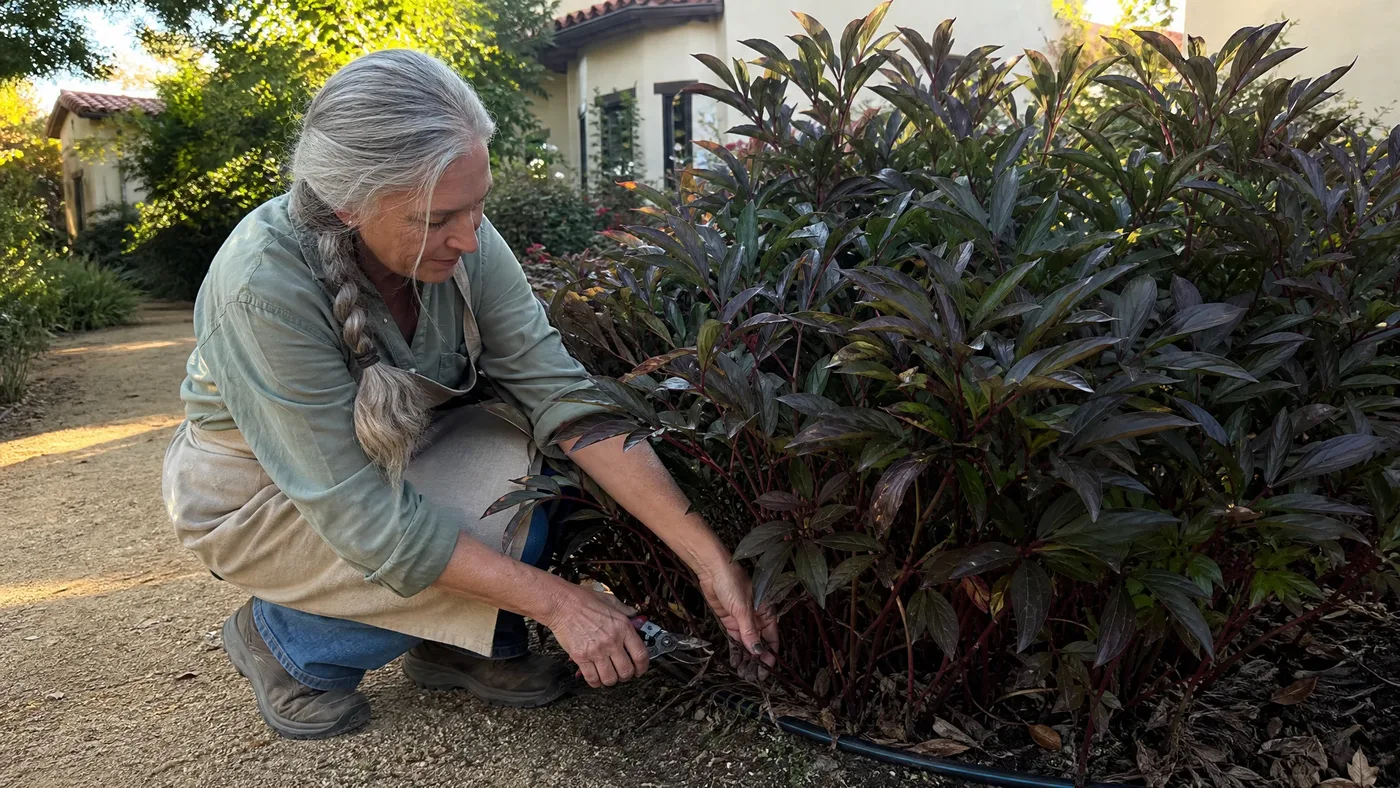
- Cut the stalks back. Cut them to just above the soil line, taking care not to nick the eyes. Our guide to when and how to prune Karl Rosenfield peony covers the details.
- Clear the bed. Remove the cut stalks and fallen leaves and throw them out rather than composting them, so leaf diseases do not carry over.
- Check the crown. If soil or mulch has piled over the eyes, pull it back so they sit just under the surface. If you are dividing or moving a clump, Missouri Extension says to plant peonies 3 to 4 feet apart, and our planting guide walks through depth.
- Mulch only if your winters call for it. In colder parts of the range, a light mulch after the ground freezes is common practice. Ask your local extension service what suits your zone.
- Uncover in spring. Pull mulch away as the red shoots appear, and keep the soil moist but well drained as they rise.
After step six the plant takes over. The shoots that emerge are the ones the eyes prepared last year, and your job is to keep the site sunny and the crown uncovered.
Two things to skip during all this. Do not heap mulch or compost directly over the crown, and do not dig around it in spring when the shoots are brittle. Most winter losses we hear about trace back to a smothered crown, not to the cold itself.
Classification Settled for Karl Rosenfield Peony
Karl Rosenfield is a herbaceous Paeonia lactiflora. It is not a tree peony, which keeps woody stems above ground, and not an Itoh, which is a tree and herbaceous cross that blooms after the herbaceous peonies. It dies to the ground each winter, regrows from its eyes at the soil line, and flowers in May and June, the steady rhythm of a plant you set once and enjoy for decades.
Your checklist for the next dormant season, in order: wait for frost, cut the stalks to the soil line, clear the debris, uncover the eyes, mulch lightly only if your winters need it, and watch for red shoots in spring.
Karl Rosenfield Peony
Nursery-grown Karl Rosenfield Peony in sizes from 2 Gallon, shipped to your door.
From $62.95
Shop Now →Karl Rosenfield gets full sun and deep, humus-rich soil in our beds, with its eyes set just below the surface. A peony that dies back every winter and returns each May is easy to settle on once you know what it is, and every plant we send out is one we raised to top quality ourselves. Whenever you want a dependable herbaceous peony of your own, pick one out for your garden.