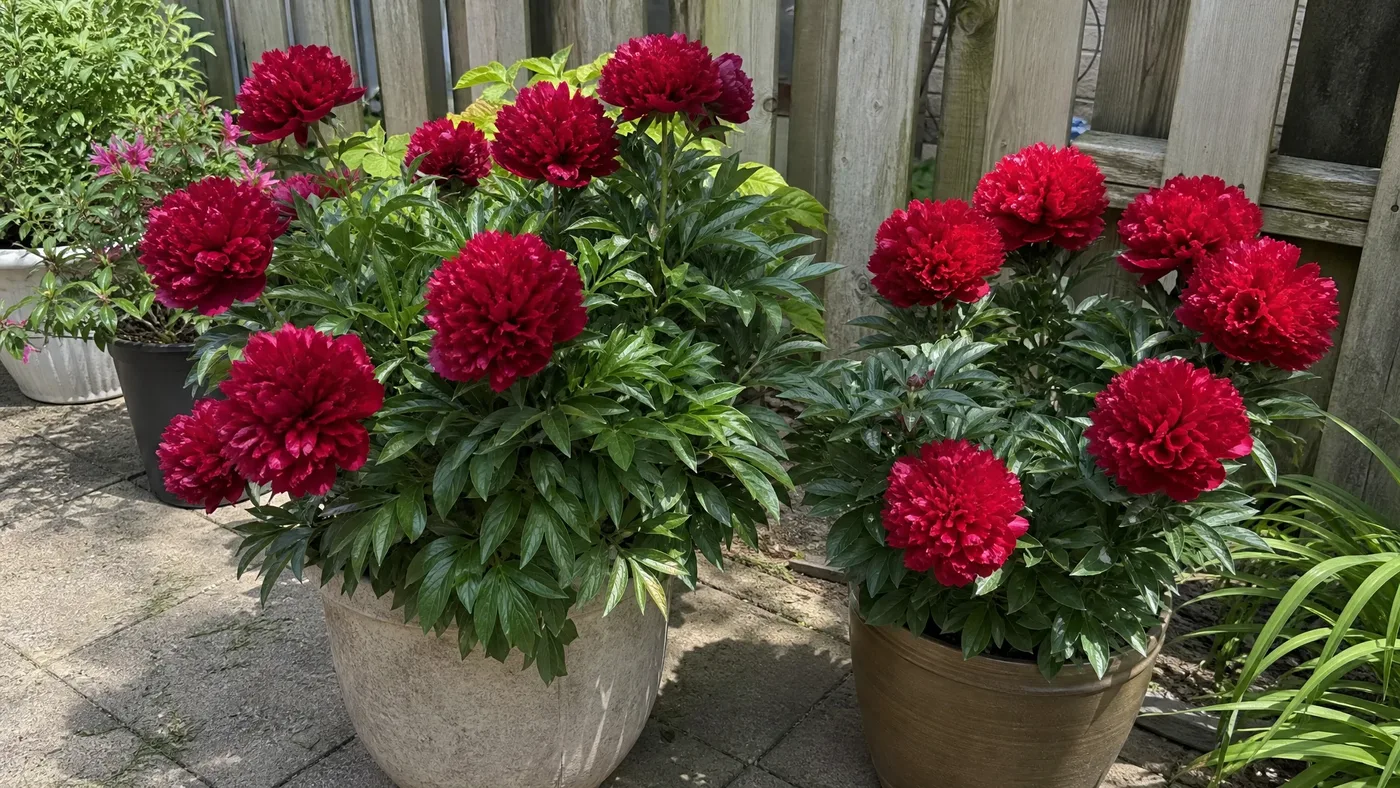
Karl Rosenfield vs Kansas Peony: Color, Stems and Bloom Time
If both are red doubles, why do the two sit on different shelves and fetch different prices? It is one of the most common questions customers ask us when they are holding a pot of each. We can't speak for what any store charges, but the split on the shelf reflects real differences between the plants.
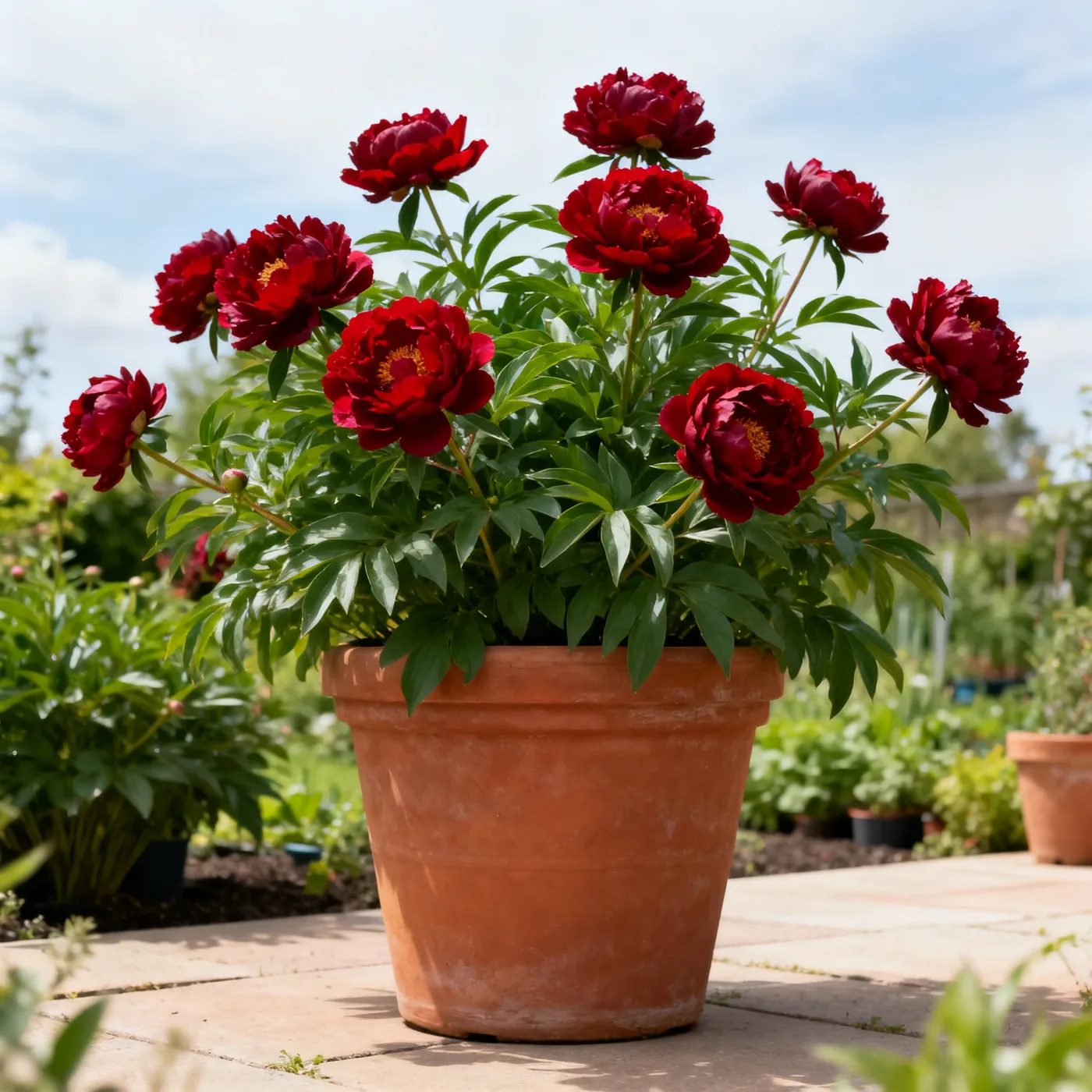
Karl Rosenfield and Kansas are both double reds in the lactiflora group, and a peony is a plant you set once and enjoy for decades, so the choice deserves a few minutes. We'll walk you through color and petal form, then stem strength and support, bloom timing, scent and winter hardiness, then the garden each one suits and the one we'd choose.
If You Want Deeper Crimson, Karl Rosenfield Peony Wins
Karl Rosenfield is a very bright crimson with very little blue in it, while Kansas is a double, bright clear red containing almost no blue. On paper the two sound identical, but crimson and clear red are different words for a reason. Crimson carries a little depth, a richness that reads almost velvety. Kansas reads as a cleaner, straighter red with nothing darker underneath.
Put them side by side in a vase and the difference is easy to see. Karl Rosenfield looks heavier and more formal, the red of an old cottage-garden border. Kansas looks brighter and more direct. If your mental picture of a red peony is deep and a little moody, you are picturing Karl Rosenfield. Many consider it the best red, and it is good for both cutting and garden decoration.
How Each Red Holds as the Petals Age
Here Kansas has the stronger record. Its buds all open and its color carries better than most reds, and it fades very little, if any. It is also a dependable bloomer every year, and it won a Gold Medal in 1957. We make no claim about fading for Karl Rosenfield, so we won't invent one.
If you want the single richest day of color and will cut stems early for the house, choose Karl Rosenfield. If your border gets long hot afternoons and you want the flower still red on day four or five, lean toward Kansas. Heat and bright sun bleach many reds, and Kansas fading very little speaks directly to that worry.
If Petals Look Flat or Crinkled, Which Plant Is It?
Mixed-up labels happen with bare roots, so some buyers need to identify what they are growing. Petal shape is the most useful clue we have. Karl Rosenfield's outer petals are large and waved, with the central petals incurved and notched. That gives the bloom a layered, ruffled look. Kansas is described only as double, so we treat petal shape as strong evidence for Karl Rosenfield and weaker evidence against it.
Work through these symptoms in order, using an open bloom rather than a bud:
- Broad outer petals with a wavy, crinkled edge point to Karl Rosenfield, because that is exactly how its outer ring is described.
- A center that curls inward, with notched petal tips, also points to Karl Rosenfield.
- Smooth, flat-lying petals with no notching and a clean red with no dark crimson depth point away from Karl Rosenfield, and Kansas becomes the better guess.
- Small, loose or sparse flowers on a young plant tell you very little. Wait for the next season before you decide.
That last point matters most. A lactiflora peony takes two to five years to reach maturity, and a first-year plant may not show its full bloom form. Judge a plant on its third or fourth spring, not its first. Our guide to Karl Rosenfield flower size and bloom form shows what a mature flower should look like.
If form and color disagree, trust the color and the plant's height together. A deep crimson on a tall plant is Karl Rosenfield. A bright clear red on a plant near 30 inches is more likely Kansas.
Karl Rosenfield Peony Stems Bend Where Kansas Stands Firmer
Both plants have strong stems, so the contrast is not strong against weak. It is height and leverage. Karl Rosenfield is tall, free-flowering and strong-stemmed. Kansas has strong stems that stand about 30 inches high. A taller plant carrying large double heads gives wind and rain more lever arm to work with. A plant near 30 inches gives them less, and that difference decides which of the two needs support after a storm.
A heavy rain can bend any double peony, because wet petals soak up water and weigh far more than dry ones. Strong stems are not the same as no support, so for large doubles in open ground we put a ring in place on both. The difference is that a Kansas in a sheltered spot may come through a storm without help, while a tall Karl Rosenfield in the open usually won't. If your garden is exposed, expect to prop Karl Rosenfield every year.
Setting a Ring in Spring
Put the support on while the shoots are still young, roughly when they stand a hand high. Set the ring or grid over the clump and let the stems grow up through it. Pushing a ring around a full plant breaks stems, and tying afterward leaves the clump looking like a bundle. A ring added in spring disappears under the foliage by the time buds fatten.
Choose a ring that sits a little below the height you expect for the stems. For Karl Rosenfield that means a taller frame than for Kansas. Check that the ring is wide enough that stems are not forced in at an angle.
Cut Stems Are a Separate Question
For the vase, Karl Rosenfield is good for cutting. Cutting also relieves the stem problem, since a flower in a vase is not in the storm. If you grow mainly for cut flowers, the taller plant gives you longer stems to work with, and that is a real reason to favor it. If you leave the blooms on the plant, Kansas is the one more likely to stand through a wet week unaided.
When Kansas Opens Ahead of Karl Rosenfield Peony
Karl Rosenfield is a midseason bloomer, and its bloom runs May to June. Exactly when that lands in your garden depends on your climate and how warm the spring runs. We have color, stem and award details for Kansas but no season, so we can't promise that it opens ahead of Karl Rosenfield. If a seller claims it does, ask to see the rating.
Many buyers want to stretch the red across a longer stretch of spring, which is a good reason to plant more than one. Our bloom time and duration guide covers how long a single Karl Rosenfield lasts. Each flower lasts days, not weeks, so the clump as a whole puts on a show of about a week or two.
If You Want Earlier or Later Red
Use the season rating printed on the label or in the catalog, and read it before you buy. If Kansas is rated earlier than midseason where you buy it, plant it beside Karl Rosenfield and you have two staggered reds. If it is rated midseason like Karl, the two will overlap, and you are choosing on color and height only.
- For earlier red, choose any red double rated early, then pair it with Karl Rosenfield to carry the midseason.
- For later red, look for a plant rated late and plant Karl Rosenfield in front of it.
- For one big flush, plant Karl Rosenfield and Kansas together and accept the overlap.
The same holds in a cold spring. Everything slides later, and the gap between them narrows.
Fragrance and Cold Tolerance Where Winters Bite
We cover two things that decide how a Karl Rosenfield does in your garden. First is its scent, which is mild, and what that means if fragrance matters to you. After that we look at winter hardiness, including how to protect young plants where the cold is hardest and what to do in warmer zones.
Scent
Karl Rosenfield is fragrant, though the scent is mild and you notice it only up close. We think that is worth saying out loud, because many people expect every peony to smell as strong as the old garden classics. Our guide to Karl Rosenfield fragrance covers what you might notice up close. We have no information on scent for Kansas, so we can't tell you what it smells like.
If scent is the trait you can't live without, neither of these is our recommendation. Buy a peony known for a strong perfume and plant the red one for color. Karl Rosenfield's gentle scent is a bonus, not a reason to choose it.
Winter Zones
Both are herbaceous lactifloras, so they share the species' hardiness. Herbaceous peonies do best in zones 5–7 but can grow in zones 3–8. We don't have a cultivar-level zone rating for either red, so treat them as equals. Our hardiness and climate guide goes further into winter.
If you garden in zone 3 or 4, mulch a new planting over its first winter and let the ground freeze before you apply it. If you garden at the warm end, around zone 8, ask your local extension service which red does best for your area. In the middle zones, either one goes in without extra fuss.
Which Garden Suits Karl Rosenfield Peony or Kansas?
Match the plant to the spot rather than to the catalog photograph. Both want full sun, since herbaceous peonies grow better in full sun. Both also need room: NDSU recommends 3 to 4 feet apart, so crowding a pair into a tight corner works against whichever you pick. The table below sorts common situations.
| Your garden | We'd choose | Why |
|---|---|---|
| Open, windy border | Kansas | It stands about 30 inches, so it catches less wind than a taller plant. |
| Cutting garden for the house | Karl Rosenfield | It is good for cutting, and it is tall and free-flowering. |
| Hot afternoon sun | Kansas | Its color carries better than most reds and fades very little. |
| Cottage border where depth matters | Karl Rosenfield | Its crimson reads richer than a straight red. |
| Small bed with limited room | Kansas | The shorter plant sits better in front of other perennials. |
If you can plant only one, we'd choose Karl Rosenfield for most gardens. It is the deeper red, it is tall and generous with cut stems, and it has the long reputation behind it. We'd steer you to Kansas if your site is windy or hot, or if you want a red that stays red as the flower ages. Our buying guide covers choosing a plant once you have decided.
Picking Your Red and Planting for Decades
Pick by the single trait you can't live without, then plant the other only if there is room. If that trait is deep crimson and a vase full of long stems, it is Karl Rosenfield. If it is a clear red that holds its color and a compact plant that stands up on its own, it is Kansas. Whichever you plant, the wait for the first full bloom is worth it.
Karl Rosenfield Peony
Nursery-grown Karl Rosenfield Peony in sizes from 2 Gallon, shipped to your door.
From $62.95
Shop Now →Our Karl Rosenfield peonies are raised in sunny rows where the ground stays moist but drains well. Before a plant leaves us, we check its roots and buds, because that first spring sets up decades of color. Every plant we sell is one we grew, and you're welcome to browse the peonies we have ready.